Kate Toumazi, CEO, Insignis
4,360 savers. 93 financial advisers. One of the largest surveys of UK savings behaviour conducted last year. Twelve months on, we have revisited the data, and the picture of how people in the UK save has barely shifted.
We are sharing this research again because the conversation it addresses has not moved on. The psychological and practical roles cash plays at key life stages are still too often overlooked, and the debate still tends to collapse into a black-and-white cash-versus-equities contest rather than a question of matching the right asset class to an individual's circumstances.
Equities have a distinct role in long-term investing. But as this research shows, the decision to hold cash cannot be reduced to a fear of the stock market alone.
Insignis has always treated cash as a core part of financial planning, for individuals and for organisations. That view still isn't widely shared, which is why we're bringing this research back to our network: to give advisers and wealth managers a firmer evidence base for the cash conversations they're already having.
Here's what it found, and what it means for the conversations you're having with clients.

UK households hold an estimated £2.2 trillion in cash deposits and savings. It’s one of the largest asset classes in British household wealth, yet the one advisers are least likely to have full visibility over.
The findings of this report give you that visibility, including: how savers think about cash, why cash is held, what savers prioritise, and the cost of inertia. Together, they point to where the conversation with clients has the most room to add value.
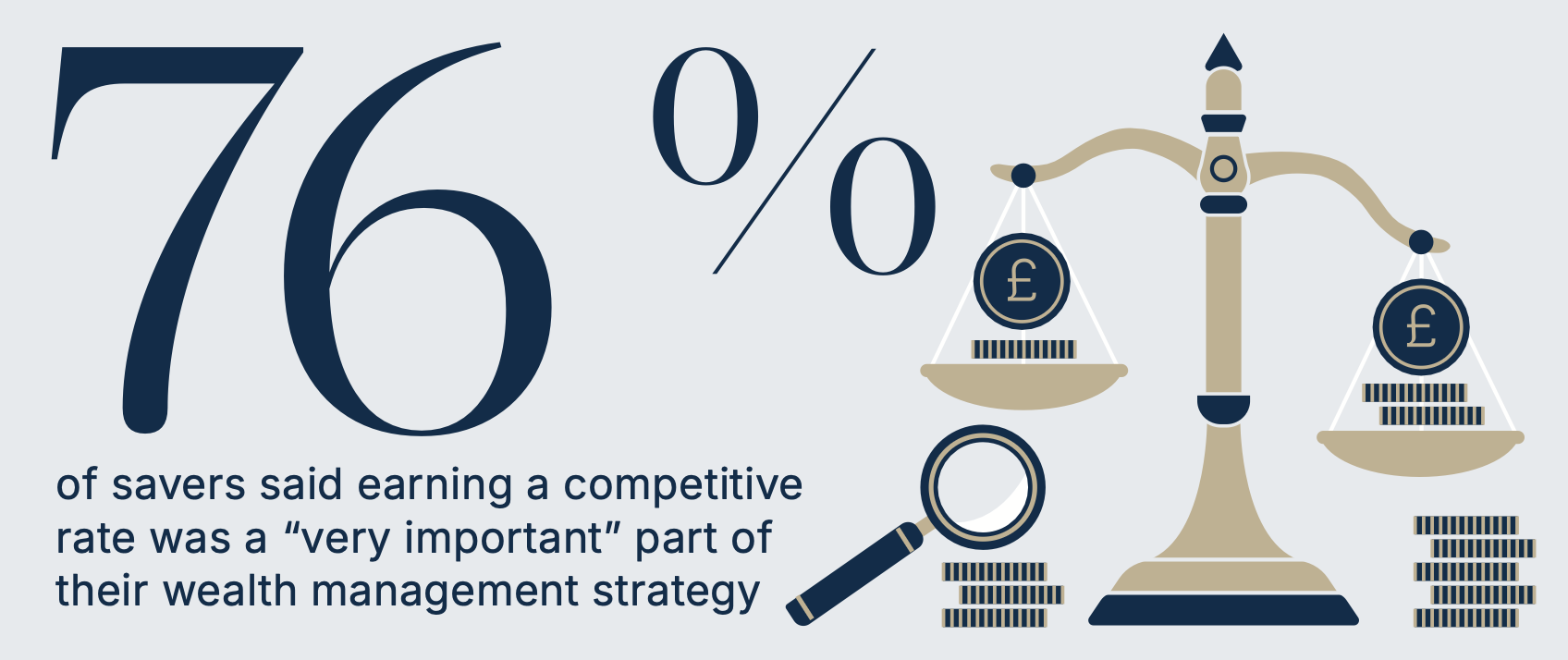
85.3% think about their cash savings weekly or monthly as part of their wider wealth strategy, and 75.9% say earning a competitive rate is very important.
The primary reason for holding significant cash is proximity to retirement (53.0%). Only 16.6% cited market volatility and 11.7% a lack of investment experience (Base: 1,975 high-cash holders).
48.1% are open to better-yielding options where access is reasonable, and a further 40.1% would move if made aware of better options. Only 11.4% prioritise instant access unconditionally.
Among savers holding cash in accounts paying under 2%, 51.2% cite an emergency fund or ease of access and 18.5% the administrative hassle of switching. Just 2.4% were unaware better rates existed (Base: 254 respondents).
79% of advisers surveyed said they regularly discussed cash with clients and 71% saw it as central to financial planning, yet 48% estimate that more than a quarter of their clients' cash still earns under 2%.
As of September 2026, the average easy access account pays 2.49% against best buys near 4.55%. At £100,000 that gap is £2,060 a year; on £250,000, £5,150.
Cash is often seen through a single, unfocused lens as either a safe haven, or a missed opportunity for greater returns. This binary view distorts its value as a strategic asset.
The findings in this report show that people aren't holding cash by accident, they're doing it with intent, even where there's real room to hold it more efficiently.
Two-thirds of advisers say their clients would switch to better-yielding accounts provided access stays reasonable. So, the willingness to move is already there. The reason for inertia is the perceived absence of an option that offers both.
The rates exist. FSCS protection levels have increased. The question that leaves is where the opportunity sits to close that gap for your own clients.
8 Devonshire Square, London EC2M 4YJ
St John’s Innovation Centre, Cowley Rd, Milton, Cambridge CB4 0WS
+44 (0)1223 200 674