UK households held around £2.2 trillion in cash deposits by early 2026, according to the Bank of England, one of the largest pools of assets in the country. We wanted to understand why this is the case, so we surveyed 4,360 UK savers and 93 financial advisers on how they think about managing cash.
We found that there is a range of psychological, financial, and political factors that shape how people manage their money. Be it retirees or younger earners, the stability of cash is often more attractive than the volatility of the equity markets, and that is a very conscious choice, not just habit or inertia.
This article looks at the key findings of our survey that explain why cash is held, and what's really driving that decision, from life stage to psychology.

Among the savers we surveyed, more than a quarter (27%) held over 75% of their non-property wealth in cash.
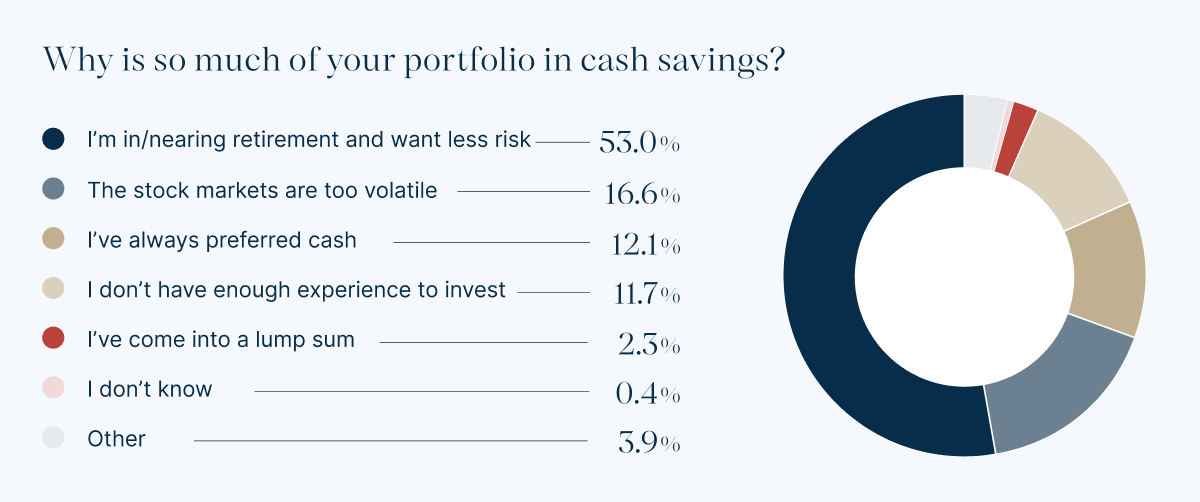
Yet only one in six (16.6%) said the reason was that stock markets are too volatile, and 12% pointed to a lack of experience investing. So what explains the rest?
Retirement, mostly. Over half (53%) of these savers hold cash because they are in or approaching retirement and want less risk, preserving value as they near the end of their working lives. Beyond that, the reasons vary: buying a house, an inheritance, a bonus or redundancy payment, selling a business, school fees, or later-life care. Cash, in this context, reflects deliberate choices around real life events. Each one is a pivotal moment that deserves careful planning if wealth is to be preserved and grown.
The life stages and reasons behind that decision have a clear implication for advice: equities remain essential to long-term growth, but they answer a different question from the one many of these savers are asking.
Every £1 saved is shaped by experience as much as by numbers. Many savers have lived through real volatility, from the financial crisis to COVID-era shocks, which makes holding cash as much a psychological decision as a financial one.
As Vicky Reynal, Financial Psychotherapist puts it:
“Cash can be a strategic financial tool with emotional benefits. Its accessibility and certainty can provide reassurance, flexibility and a sense of control, particularly during periods of transition or uncertainty. A preference for cash may therefore reflect a deliberate strategy that recognises these benefits, rather than a simple aversion to investing or an anxious holding on in a search for security.
Advisers can support clients as they try to balance financial and emotional objectives and ensure their cash reserves are held more effectively.”
12.1% of cash-focused savers told us they have always instinctively preferred cash. A further 3.9% gave a reason outside the options offered. Control, protection, tax and access came up again and again:
A preference for cash, then, is rarely passive. For advisers, it's a reminder that there's no one-size-fits-all approach to client cash. So, understanding the emotional relationship a client has with their money matters as much as the numbers on the page.
These findings are only part of the picture. The full report also looks at how account access shapes savings behaviour, the size of the gap between cash sitting idle and better-paying alternatives, and where the opportunity sits for advisers to have a more valuable conversation about it.
Download the full Beyond Inertia report to see the complete findings, and what they mean for how you manage cash with your clients.
8 Devonshire Square, London EC2M 4YJ
St John’s Innovation Centre, Cowley Rd, Milton, Cambridge CB4 0WS
+44 (0)1223 200 674