You find two savings accounts. One shows 4.00%, the other 3.95%. The first looks like the clear winner, but is it really? The rate on a savings account can mean different things depending on whether you’re looking at the gross rate or the Annual Equivalent Rate (AER).
This guide helps you understand the difference, with an example and checklist for comparing accounts, so you can choose the right one for you or your clients.
The gross rate is the annual interest rate before tax. It doesn't show the extra return you may earn when interest is paid into the account and starts earning interest itself (often called compounding).
AER shows exactly that – what you’d earn over a year once compounding is included. That's why it’s usually the better figure for comparing savings accounts. Every provider calculates it in the same way, and it’s the rate you see on ads, comparison sites and provider websites. When using Insignis, you can view AER and gross when placing funds with banks on the platform.
It comes down to when interest is paid. Interest paid monthly and left in the account is added to your balance, so it starts earning interest too, and over the year you would end up with slightly more than the gross rate suggests. Interest paid once a year doesn't get that boost.
So two accounts with the same gross rate could pay out differently, and AER closes that gap by showing the full-year result for each.
Suppose you have £100,000 to put in savings for one year. Here is how it might look.
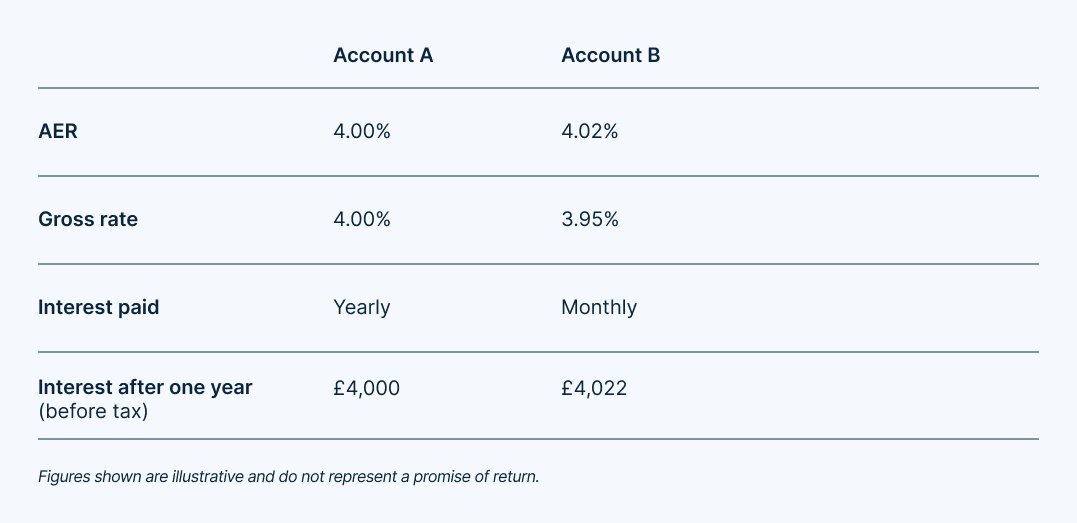
On gross rate alone, Account A looks like the better choice. But when we look at AER, Account B comes out slightly ahead, because the monthly interest payments compound over the year.
The difference in this example may be small, but it grows with larger balances and longer terms. So the point holds: the headline gross figure doesn’t tell the whole story.
The highest rate on its own is only one piece of the puzzle. Choosing the account that’s right for you or your clients means looking at how cash is actually used:
Whether it's your own savings, your organisation's cash or your clients' money, the aim is usually the same: to place cash where it earns well, spread risk, and protect it.
Going through the checklist above usually means going through banks one by one, and that takes time. Insignis gives you access to all its partner banks from a single application, with one dashboard and unified reporting for your cash.
We’re FCA-regulated, as is every bank we partner with. So you can manage money without juggling multiple applications, and move money between banks without extra forms to fill in. When you place funds on our platform, you’ll see the AER and gross rate for each account, so you can choose what’s right for you or your clients.
Delegate to your adviser or manage your money yourself, all backed by our UK-based support team. We want to help you find the right home for your cash, not just the highest number.
A reminder of key terms
See how Insignis gives you access to competitive rates from more than 55 banks and building societies through a single platform, making it easier to review and move your cash as rates change.
8 Devonshire Square, London EC2M 4YJ
St John’s Innovation Centre, Cowley Rd, Milton, Cambridge CB4 0WS
+44 (0)1223 200 674