
If you’re holding large sums of cash, eligible deposits are protected by the Financial Services Compensation Scheme (FSCS) up to £120,000 per person, per authorised institution. That’s the safety net if a bank fails. But how do you decide which banks are least likely to get into trouble in the first place?
That’s where investment-grade banks and ratings come in. A bank is ‘investment grade’ if major credit rating agencies rate it above a certain level. We explain this in more detail, how it works and why it matters – whether you’re an individual, business, not-for-profit or partner.
An investment-grade rating is an agency’s view that a bank has a relatively low risk of failing to meet its financial obligations, including returning deposits to customers. The term comes from bond markets, where many institutional investors are only allowed to hold investment-grade assets. It’s an opinion about risk, not a guarantee of safety.
The main agencies are S&P Global Ratings, Fitch Ratings and Moody’s, though DBRS Morningstar is also widely used. Agencies grade banks on a letter scale that starts with AAA and works down. Each agency labels its scale slightly differently.
This table shows each agency’s ratings, and where the investment-grade line sits.
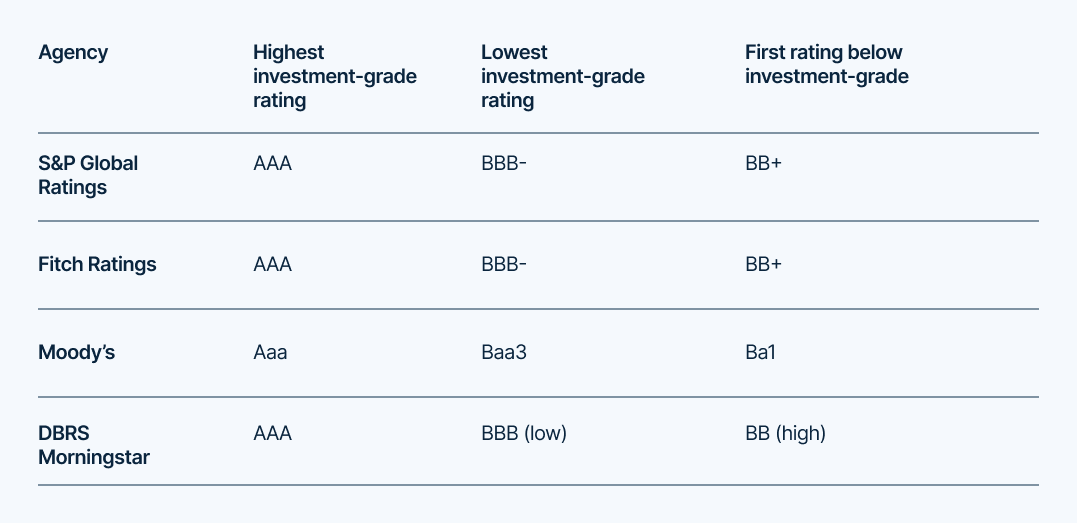
“Investment grade” counts as anything included from the highest rating to the lowest investment-grade rating. Below that, a bank is “sub-investment grade,” sometimes called “speculative grade” or “high yield.” That doesn't mean it's about to fail, but that the agency sees more credit risk. Agencies can also disagree, so two ratings for the same bank won’t always line up.
When we refer to ‘investment-grade banks’ in this piece, we mean banks that carry an official solicited rating at or above the investment-grade threshold from one of these agencies. Some providers also refer to model-based or ‘implied’ credit scores. These aren’t ‘official’ ratings and don’t count towards the investment-grade label here.
Analysts will look at things like:
They’ll also consider the economy the bank operates in, and for some banks, how likely a parent company or government is to step in and support the bank financially if it gets into difficulty.
Ratings aren’t fixed and agencies review them periodically, or when a bank’s situation changes significantly. Examples include large loan losses, a sharp fall in capital, customers withdrawing money faster than expected, or a change of ownership. Agencies can also publish a positive, stable or negative “outlook,” to signal which way a rating might move.
Three types come up most often, so it’s useful to know the difference:
1. Long-term issuer rating
This is the bank’s headline rating – essentially the agency’s overall view of how likely the bank is to meet its financial obligations over the long term.
2. Deposit rating
This is the closest to the question a saver is asking – it gives the agency’s view of how likely the bank is to repay its depositors.
3. Senior unsecured rating
This is the agency’s view of how likely the bank is to repay its ordinary bonds (that’s money borrowed from investors, not depositors).
Each rating is graded separately, using the scales above. The three ratings often match, but not always. For example, a bank could be investment grade on its issuer rating, but one step below the line on its senior unsecured rating.
That’s why “investment grade” on its own might be unclear. When you see a bank described like this, it’s useful to check which rating it refers to and which agency gave it.
Lawrence Holland, our Relationship Director for Financial Institutions, tells us, "External credit ratings, analysis and rating methodologies are an important part of how we assess banks, but we don’t rely on them alone.”
We use these alongside broader market indicators of creditworthiness and our internal assessment of a bank's overall resilience. Key factors include:
With our 55+ panel, Insignis has more investment-grade banks than any other provider. Not every bank has a formal public rating, though. In this case, we look at other measures alongside our wider assessment of the bank’s financial strength and resilience (for example, Fitch’s Financial Implied Credit Scores).
Lawrence continues, “We provide access to a diverse range of financially resilient deposit takers that have undergone due diligence and ongoing monitoring. The aim is to help clients make informed decisions about where they place their cash while benefiting from broad choice and diversification.”
Ratings help you judge risk and resilience. A bank that’s rated well above the investment grade line has more room for things to go wrong before it nears trouble. A bank sitting right on the line has less.
A rating is an independent assessment of how likely a bank is to meet its obligations, so it gives you something concrete to compare, rather than relying on assumptions.
It’s worth noting that FSCS protection and ratings do different jobs. The FSCS is the safety net if a bank fails, and ratings help you judge how likely that is to happen. Spreading cash across several authorised banks means you lower your risk if something goes wrong. Each banking licence has its own FSCS limits, but banking brands that share a licence share a single limit, so it’s always worth checking.
Where you place your cash is completely your choice, but it’s worth considering:
With Insignis, you get access to a range of savings products from a panel of UK banks and building societies, all through a single platform. Explore how it works.
Disclaimer: This article is for information only and does not constitute financial, investment, tax or legal advice. Where you place your cash is your decision. If you are unsure what is right for you, consider seeking independent advice.
Explore how to start spreading cash across multiple bank accounts eligible for FSCS protection
8 Devonshire Square, London EC2M 4YJ
St John’s Innovation Centre, Cowley Rd, Milton, Cambridge CB4 0WS
+44 (0)1223 200 674