
In the early days of business growth, a simple spreadsheet or free accounting software might be enough to keep an eye on your numbers. However, once revenues start to rise, risk and complexity almost always follow. As a result, ad-hoc attitudes to money management must be replaced by formal processes to keep growth on track and threats at bay.
That’s where treasury management comes in.
In simple terms, treasury management ensures your business has access to the right funds at the right time to meet obligations, pursue long-term opportunities, and reduce financial risk.
In this guide, we break down what treasury management is, the core features, and the signs it might be time to formalise your treasury function. We also spotlight a few tools and solutions to help founders and leaders take control of their company’s financial future at the earliest opportunity.
Treasury management is the process of monitoring and managing a company’s financial resources, including cash, investments, and debt.
As a broad, strategic function, treasury management takes a zoomed-out view of business finance, considering both short-term and long-term requirements to optimise liquidity and minimise risk. As such, it sits above other functions, like cash management and working capital management, which are more focused on day-to-day operations.
No, treasury management is different to cash management. While closely related and often used interchangeably, treasury management and cash management are two different things. It’s broadly helpful to think of cash management as a subset of treasury management, which we’ll explain further in the next section.
To give you an idea of how a modern treasury function might work, the process will typically oversee the following:
Let’s take a look at these features in more detail.
Cash management and cash flow forecasting are essential parts of effective treasury management.
Cash management makes sure a company has the right amount of liquidity to meet its day-to-day needs while maximising the use of any surplus funds. It covers everything from managing bank accounts to handling payments, collections, and short-term investments.
As part of this, treasury will be responsible for implementing cash management software to provide oversight and control over business cash.
Meanwhile, cash flow forecasting works hand in hand by providing a clear view of expected income and outgoings, helping finance teams plan ahead with confidence. Together, they support smarter decisions, reduce risk, and enhance overall financial health.
Treasury can often be the financial face of an organisation, managing banking partner relationships and monitoring payment processes to optimise costs and minimise risks.
Ultimately, effective payment and banking oversight builds trust and contributes to stability and success. Solid treasury practices also demonstrate maturity and readiness when seeking funding or credit from banks or investors.
Working capital management involves balancing current assets and liabilities, such as receivables, payables, and inventory, to make sure the company has enough cash to cover its short-term needs.
Treasury teams play a vital role in this by monitoring these areas and identifying opportunities to enhance cash flow, reduce costs, and support business growth.
Effective working capital management helps free up cash, strengthens financial stability, and allows the business to respond confidently to changing economic conditions.
A major part of treasury management is striking a balance between risk, return, and liquidity to support a company’s financial health and long-term objectives.
With this in mind, treasury teams will manage borrowing (debt) to ensure the business has access to funding when required, on favourable terms, and at a competitive cost. They’ll also be tasked with monitoring markets and identifying smart investment opportunities for surplus cash.
When a business expands beyond its current geographical borders and begins exploring international markets, it becomes exposed to currency fluctuations that can impact earnings, cash flow, and profitability.
A treasury team can help mitigate FX risk by monitoring market movements and utilising short-term FX hedging strategies to manage exposure.
Finally, ensuring your business is fully compliant with financial rules and internal policies is a key responsibility of treasury management.
By staying up-to-date with evolving laws, industry standards, and company policies, treasury ensures that all financial activities are conducted safely, ethically, and in accordance with laws and regulations. This includes everything from anti-money laundering rules to internal approval processes.
Strong and consistent compliance can protect your business from risk and reputational harm, create a culture of accountability and transparency, and build trust with stakeholders.
For early-stage companies, the above might exist as a loose collection of activities. But as your business grows, the stakes get higher and the need for structure intensifies.
By formalising your treasury function, you can develop strategies that prioritise long-term financial stability, allocate funds to promising growth initiatives, and protect against economic and operational threats.
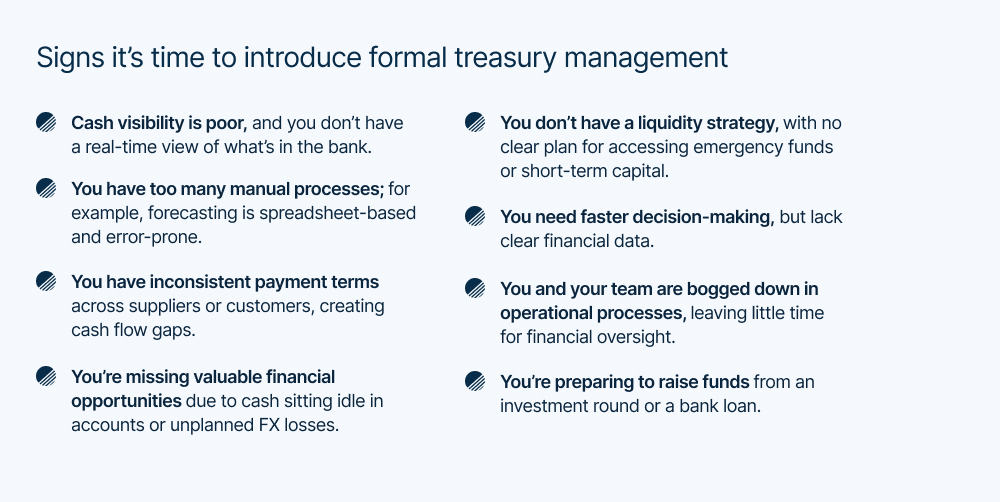
As your business scales, the following signs may tip you off that your treasury function needs urgent attention:
You don’t need to build a full corporate treasury department to enjoy the benefits of treasury management. There are flexible tools and support options for businesses of all shapes and sizes:
Depending on the size and budget of your organisation, you have several options for introducing treasury tools.
A virtual CFO or part-time Financial Director can design and oversee your treasury strategy without the full-time cost. Fractional finance teams can also implement forecasting tools and controls as a one-off project.
Read more: How to find a part-time CFO: Where to look and what to know
If you’re not quite ready to introduce a formal treasury management function, you can still take steps to improve things:
When you're running a lean business, treasury management might not feel urgent. However, once revenue begins pouring in, cash becomes tight, or cross-border complexities start keeping you up at night, it can very quickly become a critical issue.
The good news is that with the right tools, processes, and personnel, you can achieve clarity and control through effective treasury management. Once implemented, it should help your business avoid cash flow concerns, reduce risk, plan with confidence, and impress funders, lenders, and other key stakeholders.
For growing businesses, treasury is not simply a luxury. It’s a foundation. Start small, stay consistent, and don’t hesitate to bring in expert support.
Are you ready to simplify cash management, optimise liquidity, and drive financial growth? The award-winning Insignis savings platform is waiting. Learn more here.
8 Devonshire Square, London EC2M 4YJ
St John’s Innovation Centre, Cowley Rd, Milton, Cambridge CB4 0WS
+44 (0)1223 200 674