
As a founder, growing a business comes with a growing set of responsibilities. What starts with an idea and an early stream of customers can quickly expand to managing payroll, chasing invoices, building investor decks, and trying to forecast cash flow.
In the early stages, the financial side of a startup is usually straightforward enough for you to manage alone (or with the help of an accountant). But as your business scales, you’ll soon realise that you need financial strategy, insight, and direction to pursue valuable opportunities and avoid costly errors.
In other words, you need a Chief Financial Officer (CFO).
A CFO takes some of those responsibilities off your plate while adding value to your business. Unlike an accountant or bookkeeper, who deals with day-to-day financial operations, a CFO focuses on forecasting, fundraising, managing investments and investor relations, overseeing economic risk and cash management (which usually begins with reviewing your business’ savings), and advising on key business decisions.
In this article, we highlight the signs that it’s time for financial leadership, cover the various CFO hiring options (full-time, part-time, and fractional) and explain how to find the right CFO for your situation.
Sometimes, the need for expert financial guidance can smack you in the face without warning. Other times, it’s a subtle, slow burn that can sneak up on you over time. Either way, if the following scenarios feel a little too close to home, you might need to hire a CFO.
If cash flow feels unpredictable, difficult to track, or too tight for comfort, it’s time to pass the baton to a CFO. As your business ramps up, costs do too, and numbers can become scattered and inaccurate without a proper, scalable structure in place. A CFO can provide that structure, giving you a real-time picture of your cash position.
It’s not uncommon for business leaders to rely on their gut or intuition when making quick operational decisions. However, if you make significant decisions, such as pricing changes, hiring sprees, investments, or new product or service launches, without reviewing financial data first, you could face serious consequences.
For example, without visibility into margins or ROI, you could overhire, overspend, or launch/scale initiatives that lose money. Or you could underinvest in what’s actually working and miss valuable growth opportunities. A CFO can help sharpen your instincts by developing clear financial models and forecasts and providing data-driven insights.
As the old saying goes, “Revenue is vanity, profit is sanity.” While soaring sales might look and feel impressive, if they’re not accompanied by profit, they’re simply not sustainable. This situation can mask any number of concerns, such as a poor pricing strategy, narrowing margins, or runaway overheads.
A CFO can unpack what’s happening beneath the surface. They’ll dig into cost drivers, refine your pricing model, and help you understand which products/services/channels generate the most value.
You need to raise funds, but don’t know where to start. Financial models and forecasts are alien concepts, and it’s your first foray into venture capital. An experienced CFO can step in and translate, creating pitch decks, models, and reports that build confidence in your business and help secure your next round of funding.
Relying on your accountant or bookkeeper as your finance lead as you scale is a significant risk. They’re essential for compliance, but focus mainly on what has already happened when dealing with tax and statutory reporting.
If you get the numbers every month/quarter, but zero actionable insights or direction, it’s time to level up to a CFO. A good CFO looks forward, forecasting runway, shaping growth strategy, and pursuing funding. They transform financial data into strategic insights and insights into actionable outcomes.
In the early days of a startup, it can feel like you’re flying by the seat of your pants. But as you establish a foothold in your market and grow your revenue and reputation, you may wish to formalise your structure by appointing a board of directors.
Your board provides oversight, direction, and accountability, and building your first board is a rite of passage for most founders. However, while exciting, it can also be quite daunting. Suddenly, reporting and governance take centre stage, and as CEO, you’re required to present structured financials, answer complex questions, and defend your numbers with confidence.
A CFO plays a vital role in this shift from founder-led gut instincts to accountable, data-driven leadership. They prepare board-ready financial reports, support investor communications, and help you get to grips with governance and growth.
A fast-growing startup can go from a handful of early employees to multiple departments in the blink of an eye. If you need to scale up personnel to meet demand, you must be prepared for the challenges. There’s payroll, benefits, equity allocations, and personal tax to contend with, and every new hire affects runway and productivity.
Without clear visibility of headcount costs and ROI, you could overhire and burn through cash needlessly, or underhire and miss deadlines and opportunities. A CFO can bring clarity to the hiring process, modelling plans against cash flow and forecasting the long-term impact of recruitment to ensure your compensation strategies are sustainable.
Not every startup founder is financially minded, but at one point or another, all will be put on the spot by an investor or lender. If you dread questions like “How much runway do you have?” or “What is your burn rate?”, having a CFO in your corner can help.
With more polished reporting and strategic financial insight, you can start answering tough questions with clarity and confidence.
If your business is generating interest from overseas, it can be tempting to dive headfirst into a new region. However, new markets can bring unfamiliar regulations, currency risks, tax implications, and operational complexities. This can quickly outpace your existing systems, resulting in an expensive game of trial and error.
A CFO can help provide a smoother transition into a new market by assessing the cost and feasibility of entering the market, modelling financial scenarios, and cross-border cashflow. That way, you can be sure your international ambitions are strategic, not reactive.
Your business might be growing so fast that you’re attracting interest from third parties. Maybe someone wants to merge with or acquire your business, or perhaps you’d like to absorb a competitor.
If either scenario is even remotely on your radar, you need a CFO by your side. Due diligence can be intense when it comes to mergers and acquisitions, and you must ensure your books are audit-ready and your pitches to investors and stakeholders are crystal clear.
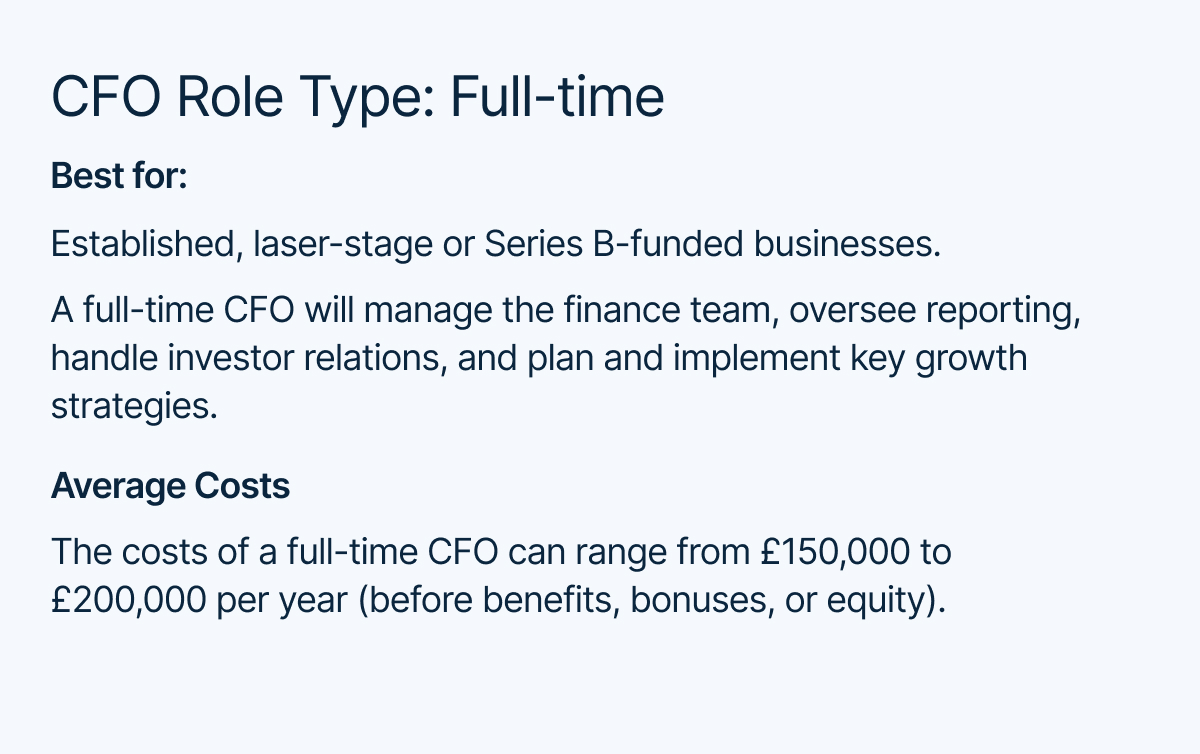
A full-time CFO will manage the finance team, oversee reporting, handle investor relations, and plan and implement key growth strategies.
Best for: Established, later-stage or Series B-funded businesses.
Average cost: The costs of a full-time CFO can range from £150,000 to £200,000 per year (before benefits, bonuses, or equity).
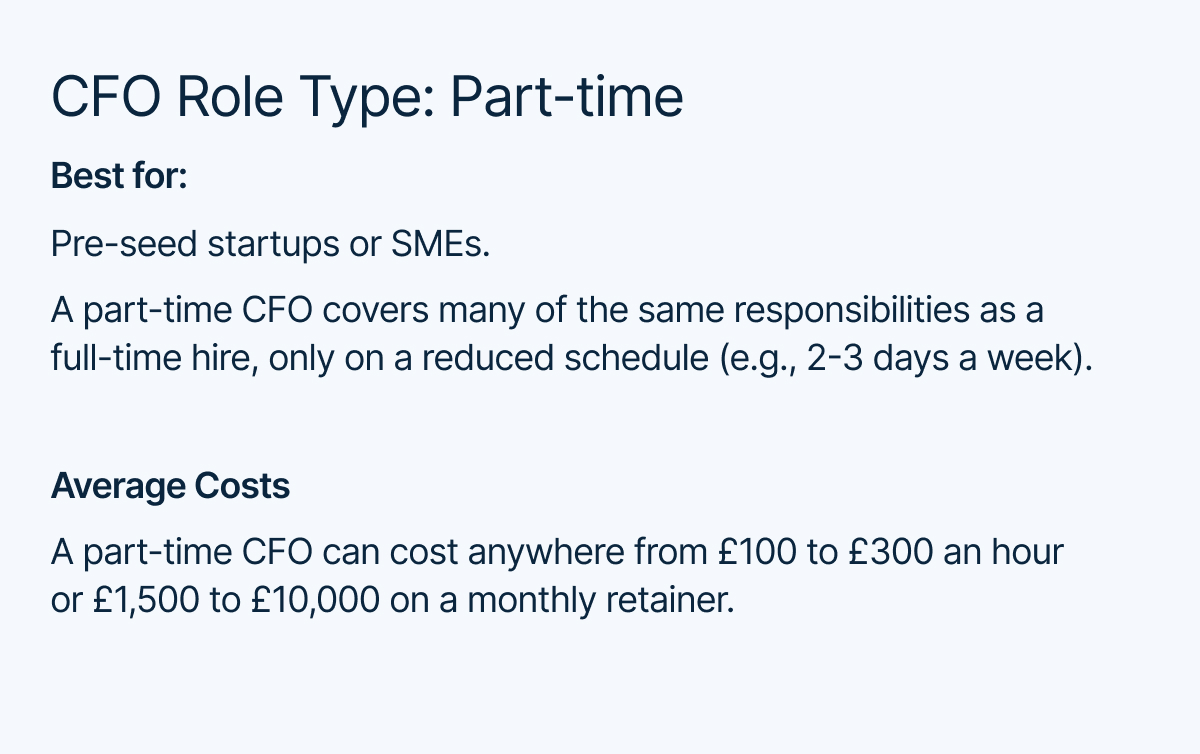
A part-time CFO covers many of the same responsibilities as a full-time hire, only on a reduced schedule (e.g., 2-3 days a week).
Best for: Pre-seed startups or SMEs
Average cost: A part-time CFO can cost anywhere from £100 to £300 an hour or £1,500 to £10,000 on a monthly retainer.
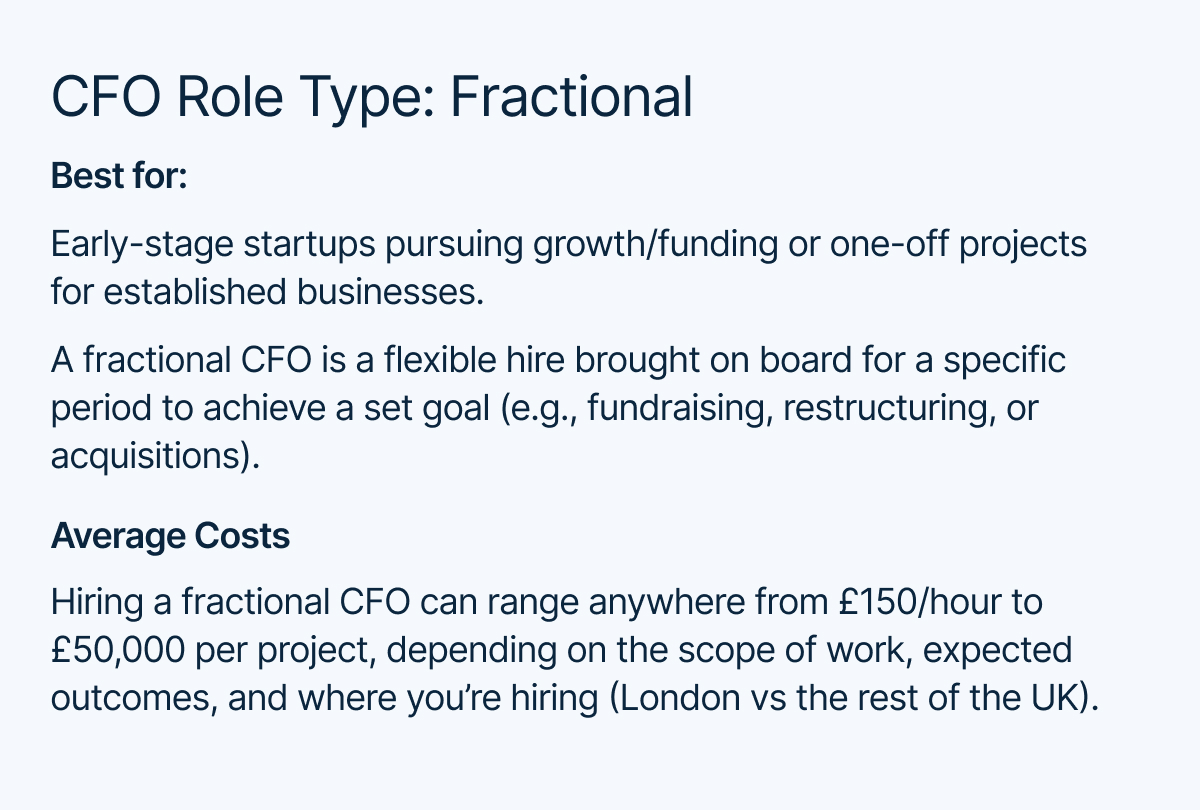
A fractional CFO is a flexible hire brought on board for a specific period to achieve a set goal (e.g., fundraising, restructuring, or acquisitions).
Best for: Early-stage startups pursuing growth/funding or one-off projects for established businesses.
Average cost: Hiring a fractional CFO can range anywhere from £150/hour to £50,000 per project, depending on the scope of work, expected outcomes, and where you’re hiring (London vs the rest of the UK).
* Note: Specialist and London-based CFOs can often command higher salaries/fees.
Now that you know why you might need a CFO and the hiring options available, the next step is to find the right one for your situation. Here are a few ideas to inspire your search.
Maybe one of the reasons above resonates with you more than the others. Or perhaps it’s a combination of some or all of them. No matter how you’ve arrived at the conclusion, understanding when to bring a CFO on board and acting on it can be a game-changer for business growth and stability.
As your company scales and financial complexity increases, strategic insight and direction are crucial. Without them, you could miss valuable opportunities or make avoidable mistakes.
A CFO can give you that all-important insight, but you still need oversight. Our award-winning cash savings platform gives you — and your incoming CFO — clarity and control over your cash reserves as you scale. Learn more here.
8 Devonshire Square, London EC2M 4YJ
St John’s Innovation Centre, Cowley Rd, Milton, Cambridge CB4 0WS
+44 (0)1223 200 674