
It’s no exaggeration to say that family businesses are the backbone of the UK economy.
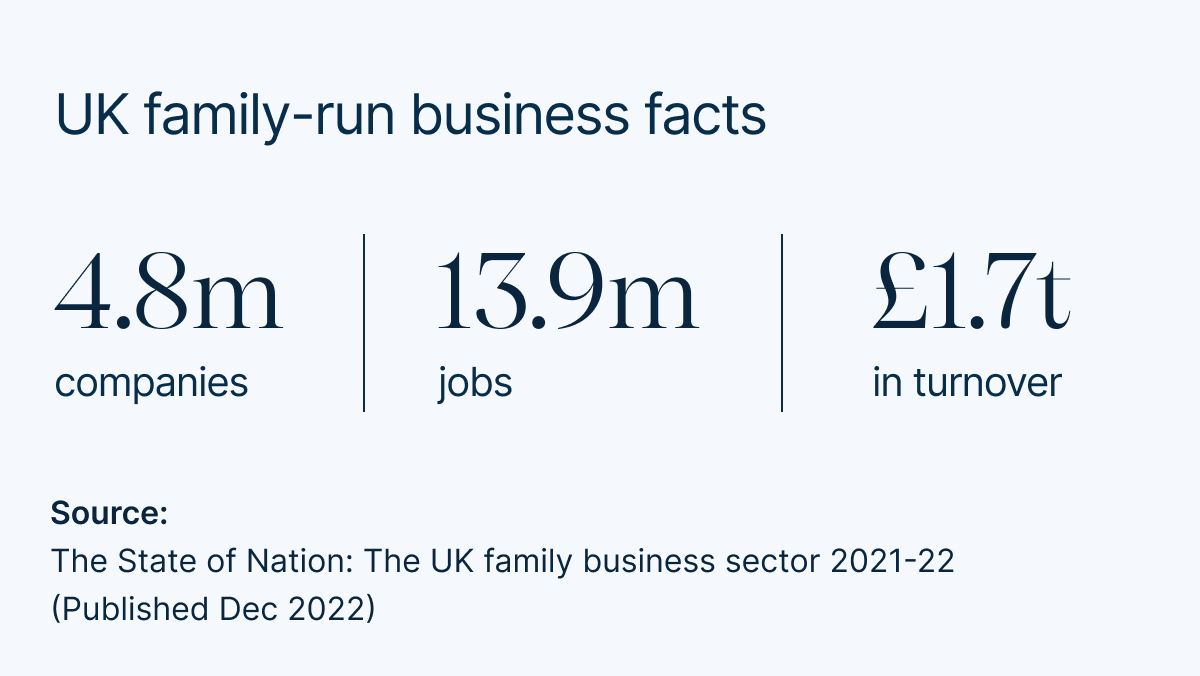
Research by ADR UK found that almost 90% of UK private sector businesses are family-run. That’s around 4.8 million companies, directly responsible for 13.9 million jobs and accounting for £1.7 trillion in turnover*.
While some of these businesses may have designs on sustained, multi-generational growth, emulating the likes of Sainsbury’s, Specsavers, and Dyson, others are keen on maintaining their place in competitive regional markets.
Whether your goal is growth or consolidation, it’s important to recognise how professional financial leadership can help you achieve your aims.
But how do you know when your family business needs a financial director (FD) to provide that leadership and guidance?
This guide highlights five familiar challenges that could nudge you into action and explains how a financial director can help you overcome them.
We’ve created this guide for key decision makers inside a family-run business, which we define by structure, not size. A company where ownership and leadership positions are typically held by members of the same family (often across several generations).
Importantly, we recognise that family businesses aren’t always “small.”
Many operate with significant revenue streams (£1M to £20M+), complex teams, and strong market influence. However, by their nature, they still retain informal processes and close-knit family dynamics that set them apart from startups or corporations.
This guide is for you if you’re a family business owner, founder, or second-generation leader who is:
Read on to discover how a financial director can provide greater control, clarity, and confidence without impacting the family values that helped build your business in the first place.
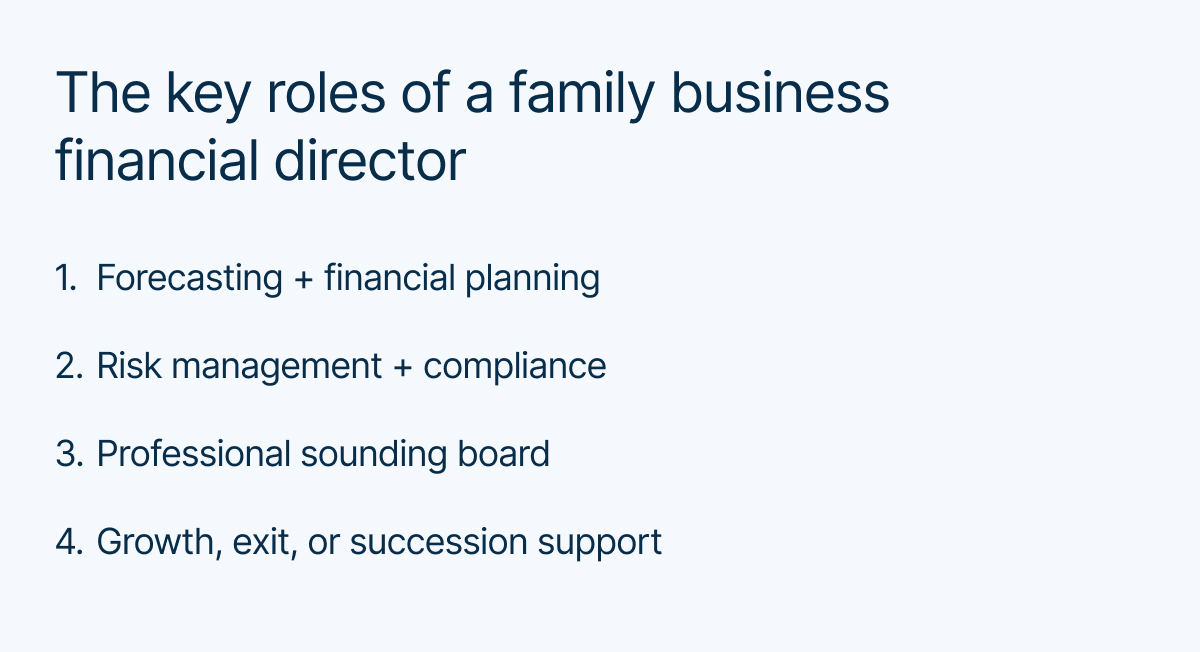
A financial director is a senior executive responsible for overseeing the big picture. Unlike an accountant or bookkeeper, who mainly deals with the day-to-day financial operations of a business, an FD focuses on tasks such as forecasting, planning, risk management, compliance, and advising on key business decisions.
In short, this is an experienced strategic leader who works with and reports to the business owner or managing director.
It’s not unusual for relationships to become strained in a business setting, but it can be harder to leave disputes in the workplace when you're family.
On Sunday, you might be a parent and child, spouses, or siblings enjoying lunch together. However, come Monday morning, you’re back to being colleagues with differing levels of authority and responsibility.
As these lines blur, it can heighten emotions, complicate decision-making, and lead to disagreements over strategy and direction. If these professional disagreements spill over into personal conflicts, they can damage the family dynamic. Suddenly, Sunday lunch becomes a little frostier.
Alternatively, it could lead family members to take the path of least resistance to avoid conflict. In this case, they might avoid taking a calculated risk to advance the business, instead choosing to preserve the status quo and keep dining table arguments at bay.
Either way, resentment can simmer beneath the surface, ultimately harming the business in the long run.
A financial director isn’t a relationship counsellor, but they can help mediate difficult situations. By removing emotion from the equation and replacing it with an objective, data-driven voice, an FD can unite family members around facts rather than assumptions.
In some family-run businesses, the hierarchy can evolve organically to resemble a family tree, rather than an org chart based on merit and expertise. In other words, the older generations assume the more senior roles, with the family matriarch or patriarch retaining control over decision-making and financial authority.
This might cause friction and resentment among younger members, who may feel underutilised or overlooked for opportunities to develop and contribute.
Plus, if decision-making power is consolidated rather than delegated, it can lead to potentially harmful inefficiencies. For instance, if the owner has to okay every new hire or sign every invoice, it can slow progress and leave the business open to threats from competitors or dissatisfaction among suppliers.
A financial director can help formalise a family business’s structure by turning informal and inefficient practices into seamless, scalable systems. With an FD’s financial discipline, job roles and departments are clearly defined, and budgeting frameworks, reporting lines, and accountability measures are implemented without bottlenecks.
During the early stages of your family business, you or other family members may have provided personal funds, vehicles, or equipment to get things up and running. However, without a shared vision for how profits are subsequently redistributed or reinvested going forward, the lines between personal and business finances can become blurry.
For example, if one family member feels “owed” by the business while another is keen to prioritise long-term growth at the expense of immediate financial gain, things can become complicated.
A financial director can help separate personal expenses from company accounts, set clear compensation policies, and establish boundaries around dividends, loans, and the use of business resources. This provides much-needed transparency and accountability, reducing tension around spending, salaries, and equity while protecting the business's financial integrity.
While a well-honed gut instinct has likely helped many family-run business owners grow their companies, relying solely on intuition can be a risky approach. You may feel you “know what works,” but if you continually make big decisions without reviewing financial data first, you could face serious consequences, especially if markets shift or costs rise.
For example, without visibility into margins or ROI, you could overhire, overspend, or launch/scale initiatives that lose money. Or you could underinvest in what’s actually working and miss valuable growth opportunities.
Instead of following a “finger in the air” approach, a financial director helps business owners test their assumptions against hard numbers. By providing financial dashboards, forecasts, and data-driven insights, an FD can sharpen your instincts and turn those gut feelings into informed judgments.
If you have one eye on retirement and you’re planning on keeping your business in the family, you’ll need a clear and proactive succession plan.
While it seems relatively straightforward in theory, there’s more to it than simply choosing your successor, signing things over, and calling it a day. Succession in a family business can often be fraught with emotional, financial, and strategic challenges if handled poorly.
For instance, tensions can arise over who’s next in line, how assets and responsibilities are divided, and whether the company structure, finances, and internal systems are set up for a smooth transition.
A financial director can bring clarity and stability to the succession process. They’ll prepare your business for handover by assessing financial health and establishing transparency around performance, ownership, and future planning. By formalising financial operations, implementing a governance structure, and helping both generations agree on long-term goals, an FD can turn a potentially bumpy exit into a slick, strategic evolution
The cost of hiring a full-time financial director can range from £80,000 to £120,000 a year (before benefits and bonuses). Of course, this can vary depending on where in the UK you’re hiring, the level of experience and expertise you require, and how you structure the engagement.
If you’re ready to look for an FD, consider the following options:
Family-run businesses can encounter several unique challenges as personal and professional lines become blurred. Hiring outside financial leadership helps to re-establish boundaries with a formal structure, fresh perspectives, and practical support.
Whether you're growing, planning for the future, or just want more confidence in your numbers, an experienced FD can set your business up to thrive in the long run, without compromising your company’s core values and relationships.
Careful cash management can help you and your financial director respond to growth opportunities or cash flow challenges. Our award-winning savings platform provides you with visibility and control over your cash reserves as your family business grows.
8 Devonshire Square, London EC2M 4YJ
St John’s Innovation Centre, Cowley Rd, Milton, Cambridge CB4 0WS
+44 (0)1223 200 674