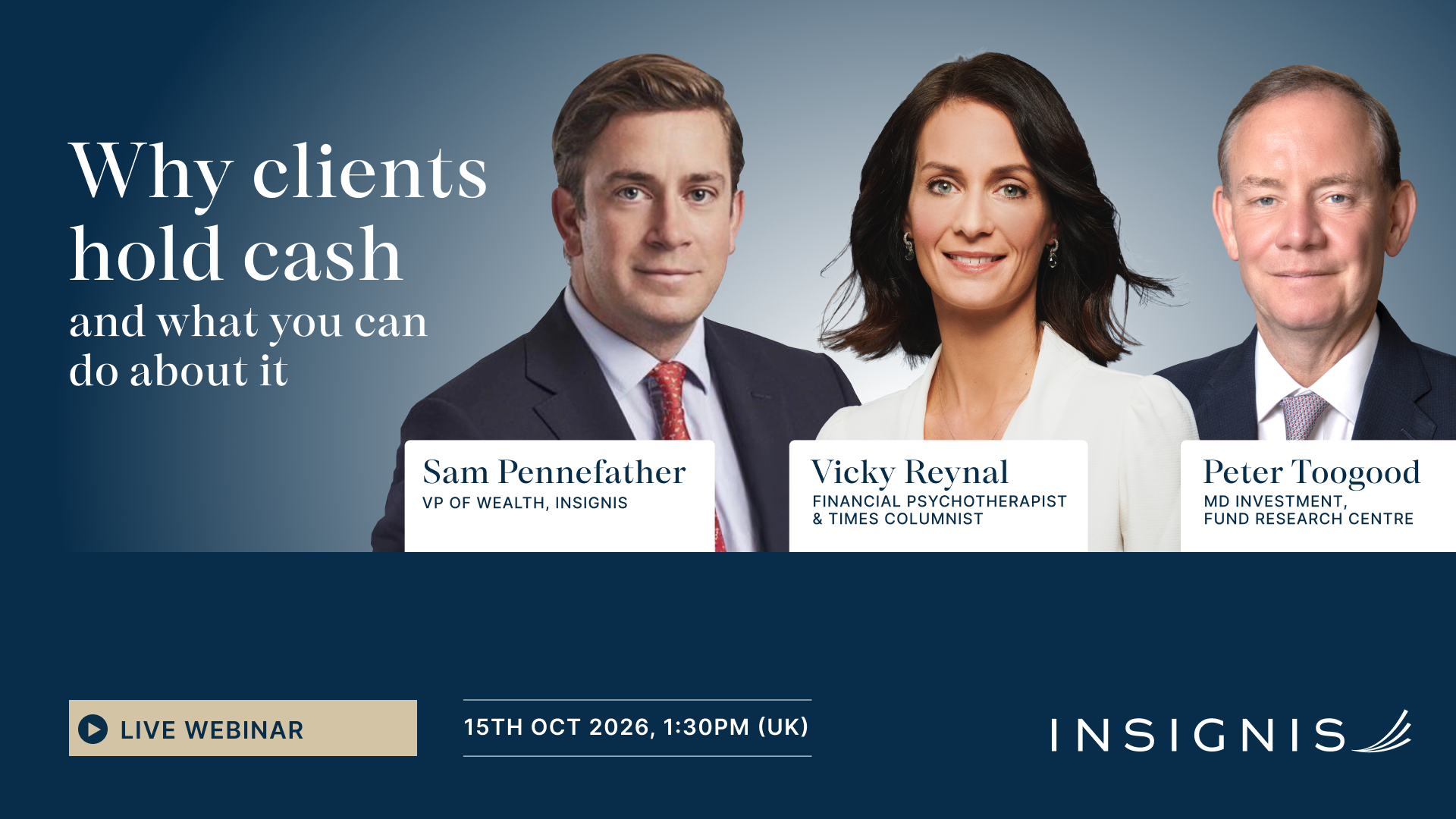
In our recent live webinar, Peter Toogood (Fund Research Centre) and Vicky Reynal (financial psychotherapist and author of Money on Your Mind) explored why advised clients hold cash and what sits behind the balance. Here is the thread that ran through the conversation, in their own words, and the question we think belongs in your next client review.
Before you decide whether a client is holding too much or too little cash, there is a prior question worth asking: do you fully understand what the money is there for?
That was the premise of our Beyond Inertia research, which drew on the views of 4,360 UK savers and 93 financial advisers. It was also the thread running through our live webinar last week, hosted by Sam Pennefather with Peter Toogood of the Fund Research Centre and Vicky Reynal, a financial psychotherapist and author of Money on Your Mind. The answer, it turns out, is rarely one thing.
Asked whether the reasons clients hold cash are "legitimate", Vicky reframed the question entirely.
“Rather than thinking about them in terms of legitimate and illegitimate, I think about them as practical reasons, emotional reasons, and then irrational reasons.”
— Vicky Reynal
1. The practical reasons are familiar. "You want to fund something imminent, you want to meet your costs in the short term, you want a buffer against uncertainty, you want flexibility at a time of change or decisions," Vicky said. "Those are straightforward." Most advisers already address these in a cash flow plan.
2. The emotional reasons are easier to miss. A cash balance offers a sense of safety that investments cannot... "it feels more concrete than investments do". It reduces financial anxiety by making the safety net visible. It gives clients a sense of agency: they have options they can act on without borrowing, selling or taking on debt. And it gives them the resilience to stay invested elsewhere.
“When markets are volatile, and certainly I hear a lot about that lately, people get really nervous, and knowing that they have a cash pot to fall back on means they stay invested rather than panic-sell.”
— Vicky Reynal
3. The irrational reasons are where advisers can add the most value. Vicky described three patterns worth listening for: cash held to meet a need for safety that no sum could ever satisfy; cash held as a defence against fears rooted in past experience of scarcity; and — the most common she sees — cash held not as a decision but as an avoidance of one.
“They're not choosing cash. It's about avoiding any other financial decision. They're stuck, they don't know what to do, and then cash is just held and not managed effectively. It taps into people's avoidance rather than intention.” — Vicky Reynal
“It's just normal. You've got a normal bond cycle you can respond to, a normal equity cycle. That means cash becomes a more interesting asset, just as an observation in its own right.”— Peter Toogood
But he was clear about the limits. Over the medium term (ten years and beyond) annualised equity returns in the region of 7–8% still do the heavy lifting on lifestyle. Cash should be a part of the plan, not a dominant part.
“You've got to get people across the line on two things: you need to invest in the medium term, and the other side of that coin, you've also got to go and spend... The biggest problem advisers have is trying to explain to clients to spend some money.” — Peter Toogood
Both panellists kept returning to the same move: before you suggest a change, understand the purpose. Vicky offered an opener that she uses when a client is reluctant to shift anything out of cash.
“Before we change anything, can we work out what this cash needs to do for you, and what you need to feel comfortable?”— Vicky Reynal
The language is deliberate. It reassures the client that they remain in control, and it moves them away from a black-or-white choice ("all cash or all invested") into a conversation about trade-offs.
“I'm sure you have other financial goals that you want to meet. How much cash can you let go of in order to still feel safe enough, but also meet your other financial needs? Then you're moving the client to thinking about trade-offs rather than black or white.”— Vicky Reynal
Peter's reinforcement was structural: bucket the money by purpose and time horizon. Short-term income needs first, then the two-to-three-year precautionary buffer, then medium-term investments, then the long-horizon pot.
“You bucket for cash, you bucket for investing shorter term — which I'd say is less than ten years — and then longer term, more than that period of time. Within that, cash forms a base for clients all the time. It can be precautionary. It can be part of an investment strategy.”— Peter Toogood
The buckets also do emotional work. As Vicky put it, when markets wobble, volatility can feel to clients as though "everything is at risk at once". The bucket conversation lets advisers show that it is not.
“You can talk to clients and remind them that it's not all existential, it's not all at risk at once.” — Vicky Reynal
Peter made the broader point about why that reassurance matters at all.
“It's a very emotional thing, which is why the idea that people are ever going to do this on their own remains far-fetched, and why advisers are important. It's an emotional journey as much as an investment journey.” — Peter Toogood
Sam closed the webinar with it, and it is as good a place as any to start:
“What do you need your cash to do for you?” — Sam Pennefather
It is a question that opens a more useful conversation than "how much should you be holding?" and it tends to surface the cash that is sitting outside the advised portfolio, in bank accounts the client has not thought about in years.
That visibility is where a well-managed cash strategy begins.
Watch the full 43-minute discussion with Peter Toogood and Vicky Reynal.
8 Devonshire Square, London EC2M 4YJ
St John’s Innovation Centre, Cowley Rd, Milton, Cambridge CB4 0WS
+44 (0)1223 200 674