
Some companies can operate for years without ever turning a profit, while others appear profitable on paper, yet struggle to pay their bills on time. Often, the difference between them lies in how they manage their working capital.
Whether you’re a founder, CFO, or finance lead, understanding how to effectively manage working capital can make or break your business.
In this guide, we break down what working capital management is, why it matters, and how to do it right to maintain liquidity, optimise operations, and support growth.
Before we delve into managing it, it’s helpful to first understand how to calculate working capital.
Working capital is simply the difference between your company’s current assets and current liabilities.
You can calculate your working capital with this easy formula:

Current assets include things like cash, accounts receivable (money owed to you), and inventory. Current liabilities include accounts payable (what you owe suppliers), wages, taxes, and short-term debts.
So, for example:
Let’s say your company has £250,000 in current assets and owes £100,000 in current liabilities.
The calculation would be £250,000 - £100,000 = £150,000
This means your company would have £150,000 of available working capital.
When you have positive working capital, it means your business can cover its short-term obligations (bills, wages, taxes, etc.) and still have funds available for reinvestment. However, if you have a negative working capital, it could lead to operational difficulties, missed opportunities, or, in the worst-case scenario, insolvency.
Working capital management involves managing a company’s short-term assets and liabilities to ensure it has enough liquidity (cash on hand or assets that can be converted to cash) to meet its obligations and fund long-term goals.
By improving how they manage working capital, companies can:
Working capital management plays a crucial role in a business's day-to-day financial operations.
In terms of its structure, it’s closely related to cash management and sits under the broad, strategic function of treasury management.
In any organisation, working capital management would typically be the responsibility of the finance team, with oversight from the CFO or financial controller. However, in smaller businesses and startups, the role often falls to the founder or a bookkeeper who handles day-to-day cash flow and payment tracking.
Whoever’s in charge of working capital management in your company, it can generally be divided into the following areas:
Accounts receivable (AR) management is the process of monitoring and managing the money customers owe your business.
By issuing timely and accurate invoices, offering early payment incentives, and following up on overdue accounts, you can ensure that customers pay on time, helping to maintain a healthy cash flow.
An essential part of AR management is monitoring your Days Sales Outstanding (DSO) — a metric that helps you gauge how long it takes to collect payments. A high DSO can suggest slow collections, which can restrict liquidity.
Accounts payable (AP) management is the process of paying suppliers and vendors strategically, without incurring late fees or damaging working relationships.
Effective AP management may include negotiating longer payment terms, taking advantage of early payment discounts, and monitoring payments to ensure they align with cash inflows.
Another critical metric is Days Payable Outstanding (DPO), which measures the average number of days it takes your business to pay suppliers. Operating with a high DPO can help you preserve cash, but an excessively high level may harm supplier relations.
If you deal with physical products, inventory can tie up a large portion of your working capital. Holding excess inventory increases storage costs and the risk of obsolescence, while carrying too little can result in missed sales opportunities.
Using a just-in-time (JIT) system can improve inventory management by ensuring raw materials, components, or products are only delivered when required, minimising storage costs and waste.
The key metric here is Days Inventory Outstanding (DIO), which measures the average number of days a company holds inventory before it’s sold. This helps assess how quickly a business can convert inventory into sales (cash). A lower DIO generally suggests faster turnover, more efficient inventory management, and a stronger cash flow.
Understanding your cash position helps avoid shortfalls and supports smarter decision-making. Regular forecasting allows you to anticipate upcoming needs and respond accordingly.
Meanwhile, balancing idle cash and operational cash ensures funds are being used efficiently, whether that’s to fund growth or earn returns through short-term investments or savings.
Even profitable businesses can go under if they mismanage working capital. Poor practices can lead to delayed payments, disrupted operations, and increased borrowing.
Benefits of effective working capital management include:
Automation reduces errors, speeds up collections, and ensures consistent follow-ups. Cloud-based accounting tools and integrated enterprise resource planning (ERP) systems can streamline the entire transaction lifecycle.
Working capital management can be a delicate balancing act, where the goal is to reduce Days Sales Outstanding (DSO) and increase Days Payable Outstanding (DPO) without harming relationships. You could do this by offering electronic payment options, establishing clear terms, and regularly reviewing supplier agreements.
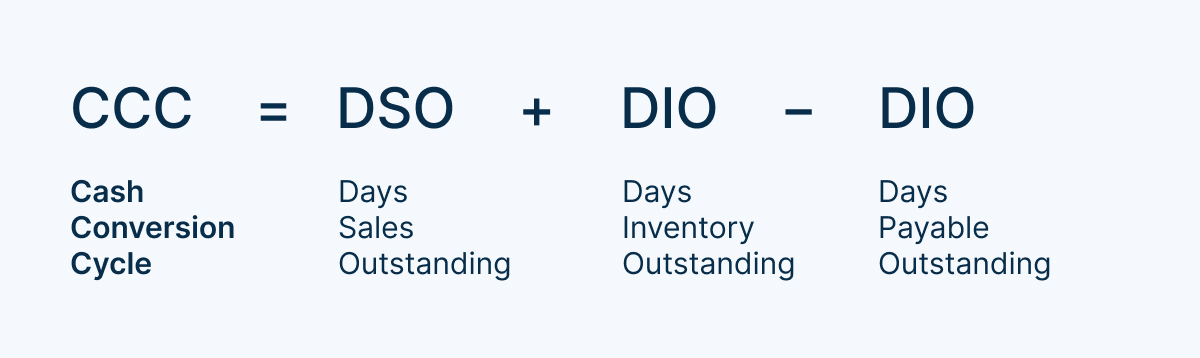
Your Cash Conversion Cycle (CCC) measures the amount of time it takes your company to convert cash spent on operations (e.g., inventory and resources) into cash from sales.
A shorter CCC means your company can collect cash from sales faster, which improves its liquidity, operational efficiency, and ability to meet its financial obligations.
To calculate your CCC, you need to add your Days Sales Outstanding to your Days Inventory Outstanding, and subtract it from your Days Payable Outstanding.
Update your cash flow and working capital forecasts on a monthly or quarterly basis to ensure accuracy and effectiveness. This helps you plan for seasonality, major expenses, and potential funding gaps.
Use data to understand which customers pay on time, which need reminders, and whether you should renegotiate terms or stop extending credit.
Several common challenges can make managing working capital more difficult, including:
If you’re ready to get to grips with working capital management, you have several options, ranging from taking a hands-on approach to software integrations and expert intervention:
Working capital isn’t just a handy accounting metric. It’s a real-time indicator of your business’s financial health. Managed well, it can unlock growth, reduce risk, and build long-term resilience.
Start by evaluating your receivables, payables, and inventory practices. Build or refine your forecasts. And don’t sit on surplus cash when it could be working for you.
Ready to make your cash work harder? Our award-winning cash savings platform helps growing businesses diversify and optimise idle funds without sacrificing liquidity. Learn more here.
8 Devonshire Square, London EC2M 4YJ
St John’s Innovation Centre, Cowley Rd, Milton, Cambridge CB4 0WS
+44 (0)1223 200 674