Most medics know that the cash they earn could be working harder. The question is where it sits on the to-do list.
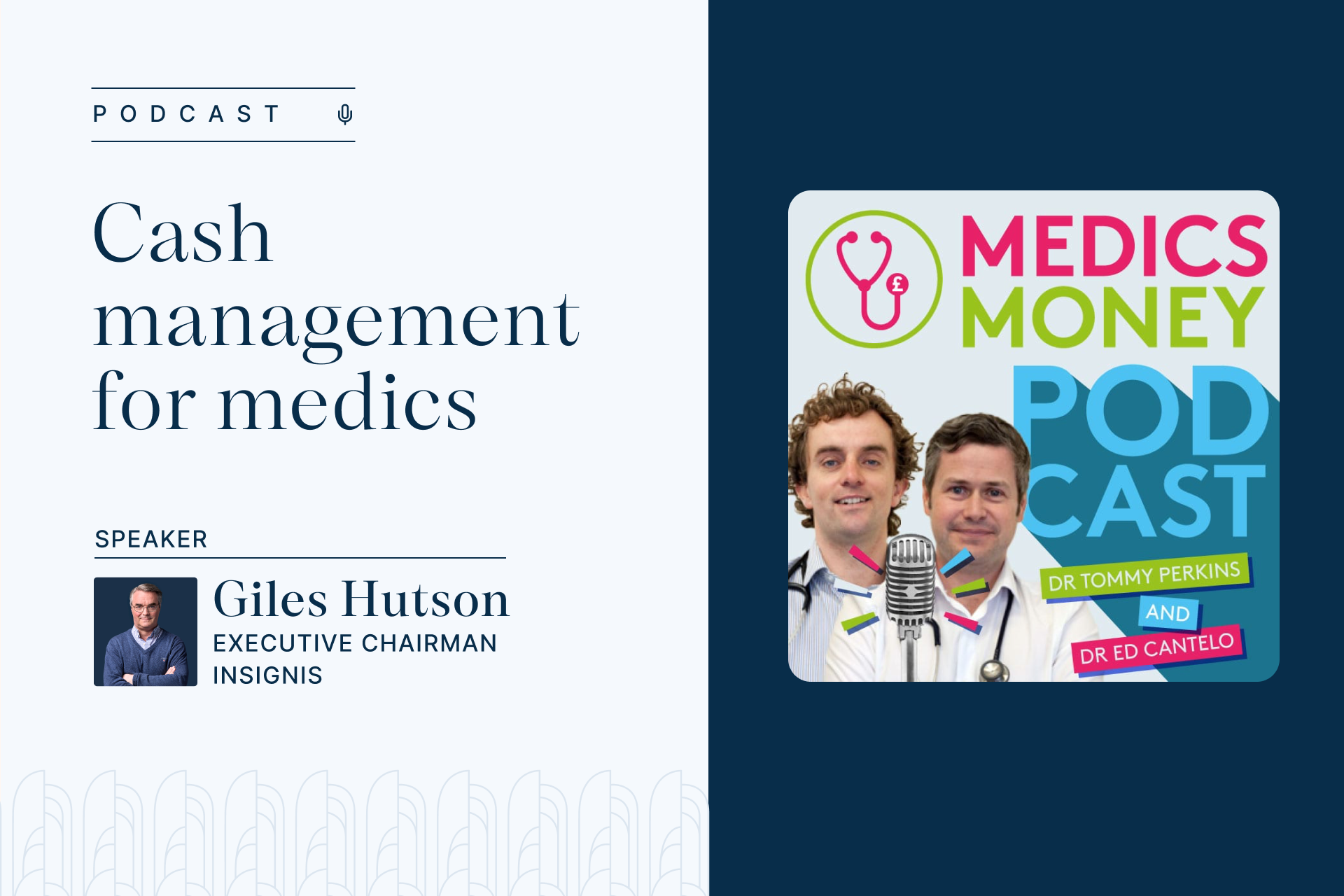
On a recent episode of the Medics Money podcast, Insignis founder Giles Hutson joined Dr Tommy to talk through why thinking about cash holdings is worth their attention and why doing something about it is often easier than it looks. This piece draws on that conversation: where the cash comes from, where the risks sit, and how a cash platform changes the picture for personal and practice savings alike.
For most of the last fifteen years, cash sitting in a current account earning next to nothing wasn’t really a problem worth solving. UK interest rates were low, so the opportunity cost of leaving cash where it was looked small.
However, the rate that can be earned on cash has changed a lot in recent years. Deposit rates have been in the 4–5% range for a while now, and the gap between a standard current account and a competitive savings product is real again, but medics’ to-do lists have more urgent tasks ahead of how much their cash is earning. As Dr Tommy put it on the podcast, you see your own bank paying 0.2%, you see 5% advertised, but most medical professionals are too busy to shop around and make a switch.
Over the course of a medical career meaningful balances build up from several places:
Cash is the “default asset class” when a property sells, when shares are sold or a practice changes ownership, the proceeds land in cash. For medics in particular, those liquidity events are increasingly common as private equity moves through the sector.
Each of those balances is often paid into a current account and left there. It’s not that medics don’t want their cash earning higher returns, it’s that reviewing rates, opening new accounts and keeping track of balances isn’t a realistic use of clinical time.
The Financial Services Compensation Scheme (FSCS) protects eligible deposits up to £120,000 per person, per authorised institution. Anything above that limit at a single bank sits outside the safety net if that bank fails.
As Giles highlights during the episode, the likelihood of a UK bank failing is low but if it does happen, the effect on the practice or household holding the cash can be severe. Averaging out the likelihood and the impact, it remains a material risk consideration for any business.
For GP partnerships, where partners are personally liable for the debts of the practice, the point lands harder still. Spreading cash with several authorised institutions keeps more of it within FSCS limits, so an isolated failure affects only a portion of cash held.
The solution is obvious: break the cash into chunks, place it across multiple authorised banks, keep an eye on rates and maturities but the challenge is prioritising it.
Each bank account means a separate application, its own due diligence, its own login, and its own account to monitor. Each maturity needs a decision. For a GP partnership or dental group, every account also needs the right signatories set up, and dual-authorisation workflows configured per bank. At year-end, someone has to pull it all together for the accountant.
Even for medics who have the time, the admin cost scales the higher the number of banks. That’s precisely why most cash ends up concentrated with one or two providers that medics have always banked with.
A cash platform gives access to many banks through a single application and a single dashboard. With Insignis, that means:
The same platform works for both sides of a medic’s balance sheet.
Personally, Insignis supports consultants, GPs, dentists, veterinary surgeons and locums with cash accumulating from private work, pension lump sums or partner drawings. Spreading cash with multiple institutions, diversifying within FSCS limits where eligible, and removing the need for a separate application at every bank.
For practices, GP partnerships, PCNs, private clinics and dental or veterinary groups can put reserves to work without disrupting day-to-day cash flow. Diversify across investment-grade UK institutions, keep clear visibility for the accountant or bookkeeper, and simplify year-end reporting.
Many medics also hold a limited company for private work alongside their practice interests. Because each legal entity has its own FSCS eligibility, a practice, a limited company and a personal holding can each be managed separately on the platform, with their own protection limits applying.
“Every client has their own personal bespoke balancing act between the time they invest in managing that cash, the risk around large cash positions, and the return profile that they might be able to get on that cash that they’re probably not getting today.”
— Giles Hutson, co-founder, Insignis
To hear Giles and Dr Tommy discuss cash management for medics in full, listen to the Medics Money podcast episode here.
Or explore how Insignis works for personal and practice cash.
Disclaimer: This article is for information only and does not constitute financial, investment, tax or legal advice. Where you place your cash is your decision. If you are unsure what is right for you, consider seeking independent advice.
Hear the full conversation between Giles Hutson and Dr Tommy on managing cash across personal and practice balance sheets.
8 Devonshire Square, London EC2M 4YJ
St John’s Innovation Centre, Cowley Rd, Milton, Cambridge CB4 0WS
+44 (0)1223 200 674